


The bar BIRN set for itself

17 Korrik 2026, 10:07Politics
TEMA
A governing party official is pressuring BIRN’s funders, and that is improper. The questions underneath his pressure are real anyway. BIRN’s answer so far, redefining its own journalist in real time, is the one response its standards do not permit.
By Ardit Rada (Tirana)
On July 15, Taulant Balla, chairman of the governing Socialist Party’s parliamentary group, posted a single word about the Balkan Investigative Reporting Network in Albania: shame. The occasion was a post on the personal Facebook account of Gjergj Erebara, a journalist long identified with BIRN, containing an image that even the press freedom network defending him would later describe, in passing, as altered. Balla did not confine himself to the image or the man. He attributed the personal post to the organization, referred to Erebara as BIRN’s editor and collaborator, named the Open Society Foundations, the Swedish development agency, European Union programmes, and foreign embassies as its funders, and announced that he would be contacting them directly.
Let one thing be stated first, without qualification. A senior official of a governing party announcing that he will take one journalist’s Facebook activity to the funders of an independent newsroom is not media criticism. It is state pressure on the financing of journalism, it is improper in every European jurisdiction Albania aspires to join, and if any part of what follows is quoted in support of it, it will be quoted dishonestly.
Now the harder part. Balla’s method is illegitimate. The question underneath it is not. And the most revealing development of the week is not anything Balla said, but what happened to Gjergj Erebara’s public identity in the days after he said it.
The quiet edit
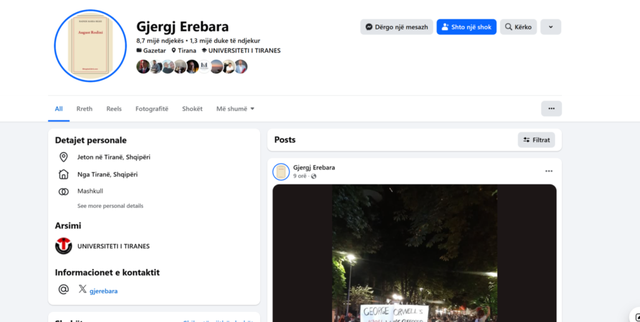
As late as July 12, Erebara’s public Facebook profile carried two employment lines: journalist at BIRN Albania, journalist at Reporter.al, with a link to the site itself. His author page on Reporter.al described him, and as of this writing still describes him, as an editor of BIRN in Tirana. By July 16, the SafeJournalists Network, in a statement written in his defense, was describing him as an external contributor rather than a staff journalist or editor. And by this week, the employment lines were gone from his profile. The header now reads journalist, Tirana, University of Tirana. The occupation survived the edit. The employer did not.
We do not know who removed the affiliations or at whose suggestion, and we decline to guess, because every available motive, his own caution, the organization’s request, a lawyer’s advice, fits the evidence equally. But the sequence does not need a motive to mean something. For six weeks, while Erebara named a protest movement, argued its case, and celebrated its casualties, his BIRN identity stood in public view. Within days of a governing party official threatening to take that identity to BIRN’s funders, it was dismantled. The partition between the journalist and the citizen, which Erebara invoked on July 15 in his own defense, I am a journalist, I am also a citizen, I protest as a citizen, was constructed retroactively, under fire, in the profile settings of a Facebook account. It did not exist in the weeks when it mattered.

Erebar’s Facebook profile on 12 July 2026
What stood in public view
The record that accumulated behind that identity is documented, dated, and in large part published by BIRN itself.
In late May, as the Zvërnec protests spread, Erebara proposed on social media that the movement call itself the Flamingo Revolution. The name caught within days; it is on the banners, in the artwork, and in the international coverage, and neutral chroniclers credit him as its author. Between June 19 and July 10, Reporter.al published under his byline a nearly daily sequence of first person essays on the movement: on revolutions and vocabulary, on anger and algorithms, on the Prime Minister’s misplaced worries, and on June 28 an opinion piece titled Revolution as an Alternative to the Endless Transition, whose thesis is its title. On June 21 an argument about tourism and concrete ran under the news category. On July 11, from his personal account, he posted a screenshot of a ruined restaurant listing, 1.2 stars in peak season, and taunted the Prime Minister that the damage was outrunning the repair. And on July 10, Reporter.al published a substantial analysis of the police investigation into the review campaign, professionally reported by a staff journalist, which at no point disclosed to the reader that the man its own author page calls an editor of BIRN in Tirana had named the movement under investigation, advocated for it in the same pages for a month, and was a public protagonist in the controversy the article covered.
Erebara is entitled to his bias. We have defended, and continue to defend, his right to protest, his right not to be intimidated, and his right not to be called a terrorist or an assailant by a press corps auditioning adjectives for a prosecutor. Bias is a right. What it is not, is compatible with the infrastructure he exercised it through. The essays ran on BIRN’s platform. The authority of the taunts was borrowed from BIRN’s name. The eight and a half thousand followers were accumulated across a career conducted under BIRN’s masthead. A man may be a citizen on his own time. He may not be a citizen through an investigative newsroom’s distribution channels while the newsroom covers his cause as news, because at that point the bias is no longer his. It is institutional.
The bar, in BIRN’s own words
The matter now belongs where it always belonged: not with the man but with the institution, and with the standard the institution wrote for itself.
BIRN’s institutional self description commits it to providing the public with impartial and reliable information. That word, impartial, is not decoration. It is the consideration in a contract. It is what distinguishes BIRN, in its own telling, from the partisan press it investigates; it is the premise on which embassies, European programmes, and development agencies fund it; it is why its findings are cited in progress reports and chancelleries rather than dismissed as advocacy. The industry codes BIRN aligns itself with are unambiguous on what the premise requires: journalists should avoid political and other outside activities that compromise integrity or impartiality, conflicts of interest must be declared and managed, and the reader must always be able to distinguish news from opinion. A high bar, set voluntarily, advertised internationally, and invoiced annually.
The question this affair puts to BIRN is whether the bar exists in practice, and the organization’s conduct to date suggests an answer it should be uncomfortable with. Consider what its own materials say about who Erebara is. The author page: an editor of BIRN in Tirana. The published staff list of BIRN Albania: seven names, an executive director, an editor in chief, five journalists, and no Erebara. His profile, until this week: journalist at BIRN Albania. His defenders, this week: an external contributor. Four descriptions, deployed in a pattern any auditor would recognize. The title expands when authority is useful and contracts when liability appears. He is an editor on the byline page and a contributor in the defense brief, a colleague when he wins awards and a freelancer when a parliamentary chairman starts naming funders.
There may be an innocent architecture underneath: BIRN Albania and the regional BIRN network are distinct entities, titles migrate, staff pages go stale. If so, the fix costs one paragraph and BIRN should publish it today. But what the organization may not do, under its own standards, is what it is doing now, which is to let the ambiguity work in both directions and hope the week passes. An investigative newsroom that demands org charts, contracts, and beneficial ownership from everyone it covers cannot respond to questions about its own masthead by quietly editing the masthead.
Why “external contributor” is not an exit
Suppose the retreat position is accurate. Suppose Erebara is, and has been, an external contributor. The institutional question does not shrink. It sharpens.
Because then the record reads as follows: BIRN’s editors, the staff whose names do appear on the published list, chose to publish a near daily stream of first person advocacy from a public participant in a live political movement, under the masthead, some of it filed as news, throughout the exact period in which the same newsroom was covering that movement, its boycott campaign, and the police response to it, without a line of disclosure anywhere. An external contributor does not commission himself. Someone edited those essays. Someone categorized one of them as Lajme. Someone decided the July 10 analysis of the police investigation needed no conflict note. Those are editorial decisions, they were made by BIRN’s own newsroom, and reclassifying the author’s employment status transfers responsibility for them upward, not away. The contributor defense does not insulate the institution. It indicts the editing.
That is the difference between this article’s question and Balla’s threat. Balla wants BIRN’s funders to punish it for its politics. The rest of us want BIRN to be exactly what it told its funders it was. The donors’ question, if they are doing their jobs, is not the one Balla will bring them. It is the governance question: where is the published editorial code, where is the disclosure policy for contributors engaged in the causes the newsroom covers, where is the register of who holds what title, and why did none of these mechanisms produce a single disclosure sentence in six weeks of coverage in which one was plainly required. An organization funded to model transparency should not need the model explained to it by a parliamentary chairman with a grudge.
What the certificate was worth
What changes this week is more than one newsroom’s embarrassment.
Impartiality of the kind BIRN sells is not a property of individual articles. It is a warranty over the whole output. The reader who trusts a BIRN investigation does not verify its documents a second time. The embassy that cites its reporting in a progress report does not repeat its interviews. The foreign editor who lifts its reconstruction of Albanian events does not commission a second one. The label does that work, and that is the entire economic function of the standard: it exempts the institution’s claims from the discount every reader applies to partisan media. The exemption is a certificate, and certificates are voided by failure of process, not by the failure of any single fact.
The Erebara affair voids the process in the one coverage area where it could be checked. For six weeks, the most prolific voice on Reporter.al concerning the Flamingo Revolution was a man who had named the movement, championed it daily, and celebrated its collateral damage, while the site covered that same movement as news, and no reader was told any of it. Which means the corpus that shaped domestic and international understanding of these protests, the reconstruction tracing the boycott campaign to Reddit forums, the July 10 framing of the police investigation as blackmail against the protest, the running chronicle of the movement’s growth and meaning, can no longer be cited as neutral. Not because any sentence in it has been shown false. Because the reader now knows a participant’s hand may be anywhere in it and was disclosed nowhere in it. A conflict disclosed is a discount the reader can apply to one article. A conflict concealed is a discount the reader must apply to everything.
And the doubt does not stay politely inside June and July, because process failures never do. Every claim BIRN has ever published now divides into two kinds. There are the claims that stand on published documents, contracts, court files, property records, budget lines, and those survive on their documentation, as they always did, because a leaked contract does not care who edited the story around it. And there are the claims that stood on the masthead: the framings, the selections, the characterizations, the stories where the reader’s trust in the institution filled whatever gaps the sourcing left. The first kind loses nothing this week. The second kind loses the only thing that was holding it up. We do not assert that BIRN’s archive is wrong. We assert something an investigative organization should find considerably worse: that as of this week, no one is obliged to assume it is right. The presumption of impartiality was the asset. The presumption is what died, and it was not killed by Taulant Balla or by any enemy of independent journalism. It was spent, in public, by the people entrusted with it.
The stakes, stated plainly
Journalism is not political activism. The sentence sounds like a slogan until a week like this one shows what its violation costs. Albania’s independent journalism sector is small, foreign funded, and under a government that has spent the past week rehearsing the vocabulary of criminal prosecution against digital protest. In that environment, the impartiality of the flagship investigative newsroom is not a matter of internal professional etiquette but the sector’s collective armor. Every embassy that cites a BIRN investigation, every court that survives scrutiny because the scrutiny was seen as neutral, every future journalist who needs the label independent to mean something, is carried by the credibility of that one word in that one mission statement. Erebara spent six weeks drawing down the account. BIRN’s response, so far, has been to edit the signature card.
The questions BIRN must answer are therefore posed here, on the public record, and they are owed to the readers who believed the label and the funders who paid for it. What is Erebara’s status, and since when. Why do the organization’s own pages disagree about it. Did BIRN request the removal of its name from his profile this week. Who edited and categorized his essays during the protest period, and who cleared six weeks of coverage of a controversy involving him without a sentence of disclosure. The organization has spent a decade teaching the Albanian public that an institution’s refusal to answer documented questions is itself an answer. It knows exactly how its silence will read.
The bar was BIRN’s own. Nobody imposed it, nobody inflated it, and nobody is asking the organization to clear anything it did not build. Its funders bought it, its readers believed it, and its own investigations enforce it against everyone else. The only remaining question is whether it applies at home, and the week just ended is not an encouraging answer. (Tirana Examiner)


Lini një Përgjigje